Friday, January 11, 2008

G is for GUR


winter jaggery
Originally uploaded by dalbhat
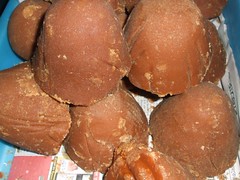
It is gur season, melt in your mouth gur.

Gur is a coarse, unrefined sugar made from the sap of certain palm trees known as khejur, and popular as an alternative to white sugars throughout the winter season.

In the mishti dokhan (sweet meat shops) everyone raves about the 'notun gur' treats that come in around this time of year. At the fruit sellers you can buy it in a syrup form or a sugar lump.

A slit is made in the khejur tree at night and a container is hung under this for collection. Early in the morning, you can enjoy khejur er rash, the sweet juice from this. To make gur from this juice it is boiled completely til all the yeast and bacteria are gone. A syrup or crystallized form can be made depending on the length of this process. As the day goes by, the rash will ferment and turn into what is called taari, an alcoholic drink.

Something I have done with the crystallized gur is to make sesame candies by roasting the sesame in a hot pan first and then melting the gur lump into that. Then, you spread the whole mixture into a pan and cut it up like fudge candy.

Wednesday, October 10, 2007

P is for PAYESH


sweet payesh
Originally uploaded by dalbhat
Nowadays birthday cakes have joined the ranks of Bengali birthday fare but not so long ago when a little girl or little boy’s birthday came around in Kolkata, you would be more likely to see mothers or grandmothers lovingly preparing a richly sweet rice pudding dish known as payesh than buying a store bought cake. Actually you will usually get both in these times!

The rice that is often used for payesh is a tiny-grained rice known as Govindabog, "the only sustenance worthy of being offered to Prince Govinda.” This grain is similar to a baby basmati as it has a nice aroma and is said to have been revered by the Moghuls who built the Taj Mahal, reserved for honored guests.

Even though it's small, it's really considered a long-grain rice because its length-to-width ratio is 3:1. It's size makes it quick to cook, so perfect for payesh where it needs to be cooked up in the milk.

Though the recipe will vary from household to household, you can follow something like this to get the feeling (and hopefully taste):

Bengali-style Payesh

3/4 cup short grain rice (Govindabog)
4-1/4 cups milk
bay leaf
1/2 cup sugar
2 tbsp cardamon
12 cashew nuts
10-15 Raisins

Soak the rice in water for 15 minutes. Heat the milk on medium flame. Slowly add sugar to the milk and keep stirring. When the milk starts to boil, add the rice slowly to it. Remember to keep stirring the milk continuously. After about 20-25 minutes, when the milk has thickened and the rice grains have become soft, add the cardamon – stir gently. Remove the container from flame and add almonds sliced into half and raisins on top. Cool the payesh and keep it in refrigerator for a couple of hours. Serve chilled.

Happy Birthday to you!

Wednesday, August 22, 2007

G is for GEMSTONES


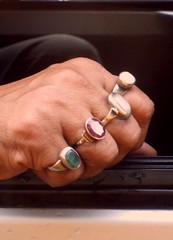
astrorings
Originally uploaded by dalbhat
These heavily laden knuckles are not just a fashion statement...although for a long time that's what I thought. It is hard not to notice that just about everyone has these rings on! I started asking some questions. Major life transitions will often lead a person to sport a new rock or metal on their hand or around their arm. For example, students may suddenly have them on their fingers in order to concentrate and do well on exams, newlyweds have them to learn how to manage their temper and get in sync with their new partner, a graduate may wear one to bring in prosperity. And if you ask, you nearly always get the reply that someone else (Ma?) insisted that they see an astrologer, who treated them with a specific remedial gem.

Here, according to Vedic astrology, gems ward off the evil effects of planets and enhance the benefits of certain beneficial planets, while also adding to someone's beauty and character. Gems are thought to have curative powers, and are able to "change the stars" in someone's direction. If you need help in keeping the mind calm, increasing income or greatly reducing wasteful expenditures, there should be a gem remedy for you.

I agree that they do indeed add to the wearer's character and personality.

Monday, August 13, 2007

S is for SHIL-NORA


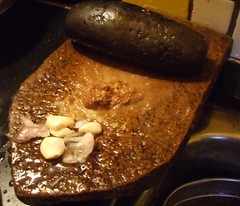
shil_nora
Originally uploaded by dalbhat
This is the grinding stone used in most Bengali kitchens, to make masalas like posto (poppy) paste and mustard sauce for fish dishes!

It weighs a ton though I have imagined carrying it abroad with me more than once.

On Sundays, our complex opens its doors to the many vendors who come around singing out their various ads. One of them is the stone grinder, who chisels designs like fish motifs into the pointy end of the stone so that it can once again give optimum performance.


Indrani Sen wrote a paragraph in the Guardian Observer (11/19/06) that best seems to capture how the shil-nora makes its presence in the kitchen:

Kneeling beside Rani-di as the morning sun warmed the patio, I learned how to use the shil nora to grind the essential pastes of Bengali cooking - onion, ginger, dried red chilli, garlic, cumin and coriander. She showed me how to roll the mortar back and forth on the pocked stone slab, pausing to reposition the paste with wet fingertips.

Labels:

Monday, January 22, 2007

S is for SARASWATI


saraswati_2
Originally uploaded by dalbhat.
For a few days before the Saraswati festival, local markets see a surge of color as hundreds of Saraswati images, in a range of sizes to suit, are displayed for sale. The day before Saraswati Puja, the images can be seen out and about the city, propped up carefully in the back of van rickshaws and trucks as they make their way to homes where studious Bengalis dwell, post offices, or institutions of learning where pujas for the goddess of learning are sure to happen. Then the morning arrives, as you wake to the day there is a faint beating of drums or blasts from sound systems that were rented out for the day. Loud speakers are being tested. And wafting through the air is a delicious nutty and wholesome smell as huge pots of a dal-rice hodge podge known as khichuri are cooked up to feed everyone around.

Saraswati is actually the goddess of all the creative arts, particularly that of poetry and music, learning and science. She dresses modestly, as she prefers the pursuit of knowledge to things material. She gracefully rides on a swan or a peacock, and is often seated on a lotus flower. She is master of the veena.
In Bengal, children place their books in front of the image on this day to ask that her powers help them to do well at school, and in classes where they are particularly weak.

Young people living in a community are most enthusiastic about this festival and many schools hold special ceremonies on this day, with the khichuri pot brewing in the background and friend potol or begun frying up to accompany it. Students and postal carriers go door-to-door the week before to gather donations so that the celebrations can happen. Girls wear yellow ("basanti") sarees with splashes of red. Makeshift "altars" have been set up all around to celebrate the occasion. Time to put the hard-core, high-pressure studies away and enjoy a dance and big meal!

Saturday, September 30, 2006

B is for BANANA FLOWER


banflower
Originally uploaded by dalbhat.
Growing up in upstate New York didn't grant me many opportunities to see bananas growing in the wild. That's why I was surprised to learn that a banana "flower" actually exists and is used in a tasty seasonal "mochar" dish here in Kolkata.

In the initial days of growth, the banana plant stem remains under the soil, with the fruit remaining on top. Gradually it grows above the soil in a full-fledged tree with the flower dwindling down from the tip. The extended stem remains inside called 'thor' in Bengali. The flower or 'mochar' in Bengali has three variety - male, female and sexless flower. Along with the typical banana fruit, the flower, when in season, is also sold in local markets.

The banana flower is deep purplish-orange color and forms on long drooping stalks. If you open the inside, you can see small flowers that would turn into banana. This is what is used to make the Bengali mochar curry dish here in Bengal. The process of removing all these small flowers is quite tedious, and then they must be soaked for quite some time in salt water to remove the bitterness before cooking.

'Kaancha kola,' or green banana is also used widely in cooking here.

Saturday, September 09, 2006

D is for DURGA


durga_vidyas
Originally uploaded by dalbhat

Durga is the demon-destroying goddess worshiped during an annual homecoming festival called Durga puja. She is annually welcomed back each year into the homes, communities and more importantly, the hearts of Bengalis according to the lunar calendar. She is elaborately treated as a guest in the city and in larger family homes until it is time for her to be sent back to the Himalayas, which is symbolized by a parade of music and dance that ends with her immersion into the Ganges.

Durga has ten arms holding Sword, Conch, Discus, Rosary, Bell, Winecup, Shielf, Bow, Arrow, and Spear, all gifts from the gods so that she would be able to slay Mahish, the demon. These tools reflect Durga's supremacy in controling evil and good forces within the universe.

My favorite part of this 4-day celebration and ceremony to welcome the goddess and send her off again is happening right now, long before the drummers and priests get here to do their thing. Laborers who are skilled at making the temporary bamboo structures that house Durga come from the rural districts about one month before the festival begins. With each passing day, these "pandals" rise up all over the city. At first they look just like scaffolding, but gradually take shape as pillars and windows and entranceways are built into them; they are then wrapped in huge sheets of cloth and decorated creatively by these rural artisans who come up with new (and sometimes pretty whacky) ideas each year. Sometimes they build the pandal to reflect a news event that happened during the year (this year it was the little boy who fell into the tubewell) or mold the face of the demon into a head-butting football player, etc. It's all in good fun and works to escalate the excitement for dressing up in this year's best and going hopping from one pandal to the other to welcome the goddess and say a prayer for safety and plenitude.

The pandals had me fooled the first couple of years...I thought they were real cement buildings until I started to notice the actual construction going on beforehand.

As you can see, Durga pervades every nook and cranny of the city during this season -- even the java joints!

durga in my coffee